


 All Programs

Art That Explores Freedom, Alienation, Eschatology and the Mythology of Late Capitalism

An Interview with Milada Kopelevich
Hi everyone! Welcome to issue 18 of our #ourstudents series — a series of interviews where students talk about themselves and their art.
The subject of this issue is Milada Kopelevich, an artist with more than 14 years of experience and an academic education. She was born in 1991 in Kazakhstan, and that fact became the seedbed for everything she has made since.
A childhood ruined by social upheaval, the chaos of a new state being born, the global turbulence of today — these are her main sources of inspiration.
Milada, you have a serious academic background. Many artists today don’t get a professional education. What did the academic school give you?
I have more than 14 years of experience working as an artist, 10 of which I spent at art schools and the Academy. The Academy instilled a serious attitude to the profession, taught me discipline and developed a solid visual literacy. The most important thing the academic school gave me is craft. My student years were a period of experiments and searching, so by the end of my studies I already had an established arsenal of technical devices and favourite themes — which greatly shortened the search for my own language and style and sped up my entry into contemporary art.
Many artists with an academic education struggle to define themselves after university. Did you go through a stage like that? How did you get through it?
Nothing like that happened to me, because during my studies I always defended my own boundaries internally and never lost myself imitating the authorities. The question “what on earth do I paint after the Academy” simply never came up. The themes that interest me as a person wove themselves naturally into my work, and I was spared the agony of searching for something “of my own.”
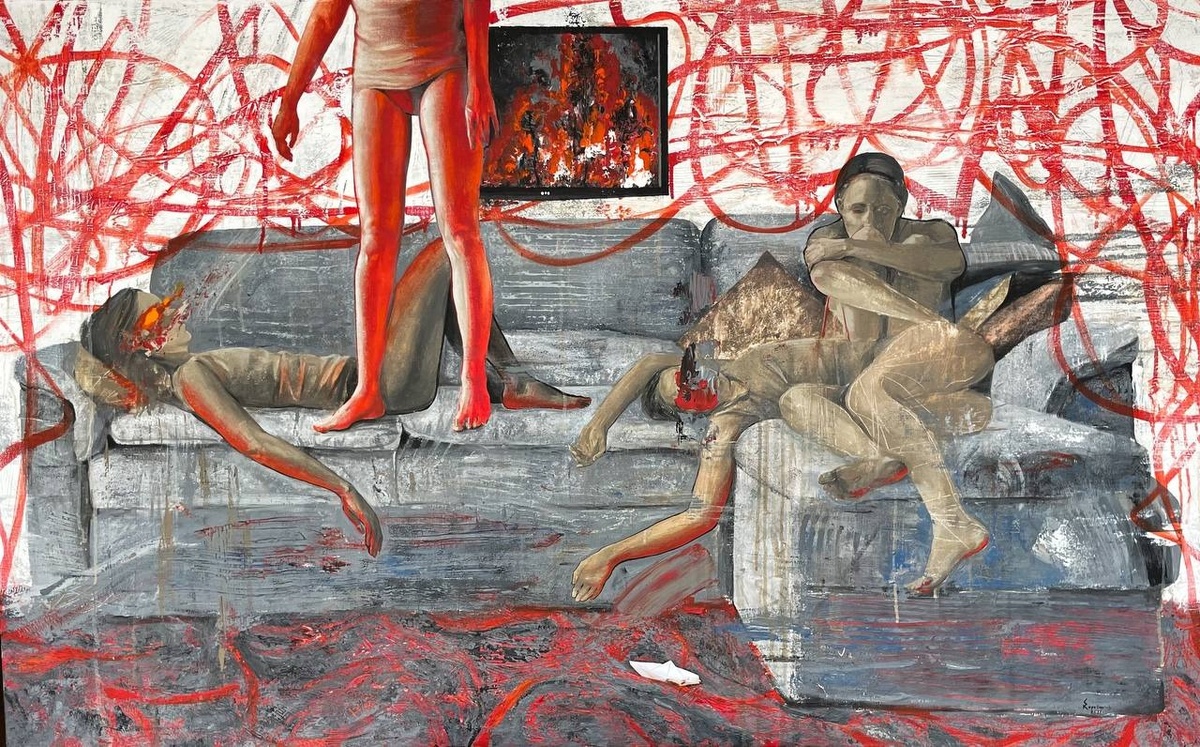
What, for you, is the main difference between the contemporary path and the traditional path of an academic artist? What would you advise those who are afraid to try contemporary art?
In my view, the main difference is the frame of reference. A classical artist relies on the traditions of classical aesthetics and follows canons of beauty and harmony, which can end up being limiting. Those laws and rules can be taught and instilled; it is a clear system with a defined “good” and “bad.”
A contemporary artist, on the other hand, won’t be guided only by the laws of harmonious composition, but will look for the language that suits their themes — even if that language turns out to be anti-aesthetic.
My advice: drop the constraints, stereotypes and conventions, and accept the art world with all its contradictions. The basic principles of academic art are only a foundation you can build a contemporary practice on, not a list of limiting rules.
There’s a line by Vasily Surikov I like:
You should study at the Academy, but you shouldn’t follow the academicians’ instructions too closely. Art is big, and it won’t fit inside academic walls.
However universal the laws and rules of classical art may seem, you have to be able to free yourself from them when the creative search for truth demands it. “An absolutised truth becomes an error” — or, in the words of Obi-Wan Kenobi: “Only a Sith deals in absolutes. May the Force be with you!”
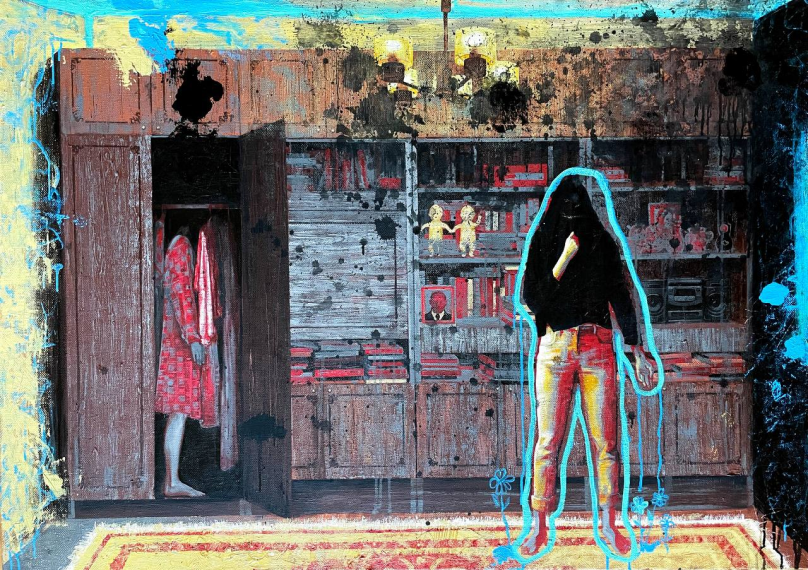
Tell us about your art: what media, materials and subjects do you work with?
The foundation of my method is figurative traditional painting. Central to my research are the concepts of freedom and alienation, eschatology and the mythology of late capitalism — multifaceted and often paradoxical concepts.
Seismic shifts in politics, economics and culture form the social fabric from which I assemble my composition-stories about an alienated generation wrestling with its identity and searching for meaning in existence.
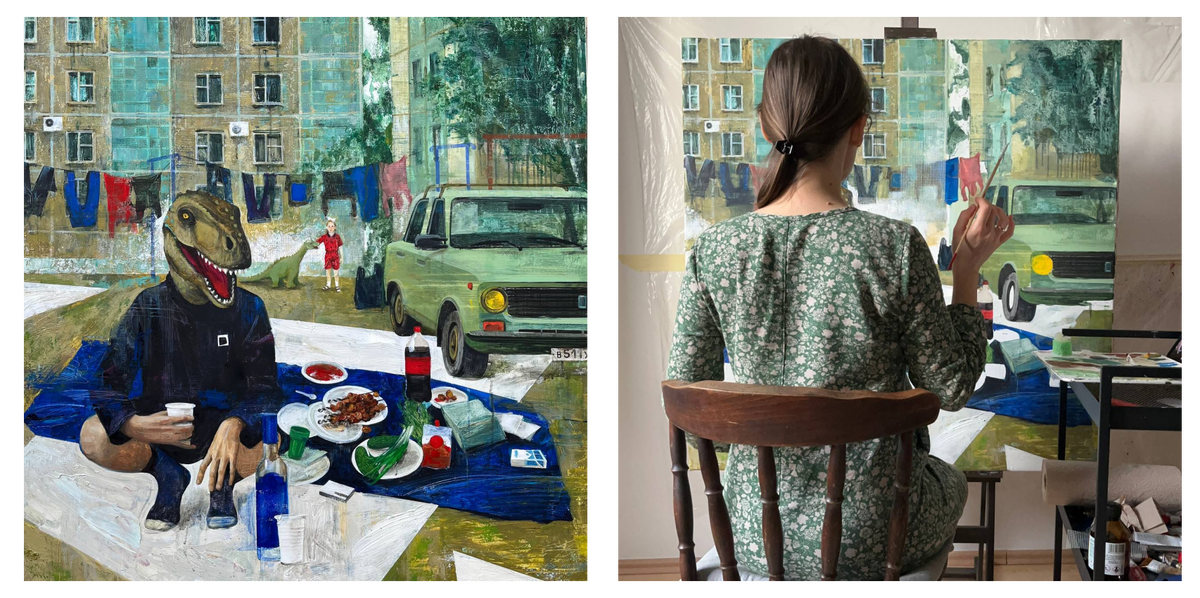
Would you like to talk about one particular work in more detail?
Recently I tried working with plastic children’s mosaic — the kind you assemble from 5 mm beads and fuse with an iron. These mosaic pieces will become part of a new project I prepared on this course. The project became a reflection on growing militarisation worldwide. In it I’m interested in the origin of violence, as in the biblical story of Cain and Abel.
What’s the process behind making the works?
A digital sketch, drawing it out on canvas, acrylic or spray paint, oil, signature)
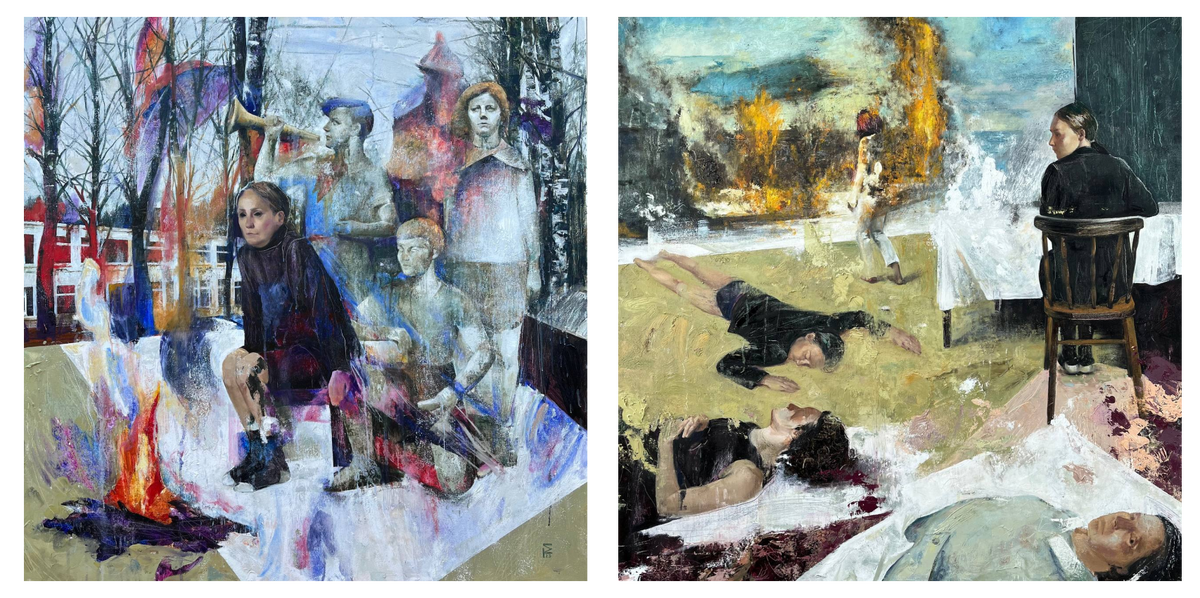
What’s important to you in art (both your own and art in general)?
From art in general, and from my own in particular, I expect philosophical depth, intellectual substance and craft.
What have been the most important moments in your art so far?
Graduating from the Academy and closing the academic chapter of my work, the first contact with a European gallery, and starting to prepare my first fully realized solo project.
Has studying on our program been useful for you?
Definitely yes. Over the course of my studies all my art documentation was rewritten and a solo project was prepared from scratch. I gained a clear understanding of how the art world is structured. I read dozens of books. I gained confidence in my practice. Structural goals and ways of reaching them took shape. Contemporary art became closer)
And the most important thing — the result! I signed my first contract with a gallery, and without exaggeration it is thanks to the professional support of the whole course team. Not only theoretical support, but in large part emotional too. Nobody understands artists the way Maria does💓
Want to build a career in art?
OnStudy online programmes, led by curator Maria Hiltunen-Sedoshenko: art management, selling art and building an artist’s career.
 WhatsApp
 Telegram
 I have a question

