


 All Programs

Art bound up with human nature and psychology

An interview with Lyubov Belaya
Hi everyone! Welcome to issue 17 of our #ourstudents series — a run of interviews in which our students talk about themselves and their art.
This issue’s guest is the interdisciplinary artist Lyubov Belaya.
Tell us how your path as an artist began.
About ten years ago I took up photography. It opened up the world of the great masters. It became clear very quickly that an artist’s medium isn’t there to state some subjective fact — it’s a tool. You use it to sculpt a thought, to make it visible.
Then came an interest in ceramics. I spent two years studying the technology. You’d think everyone takes photographs these days and plenty of people work with clay. But the deeper I went, the more I understood how complex the chemistry of these crafts really is. And I saw that combining that knowledge opened up new possibilities for me.
With that behind me I enrolled at the Rodchenko Art School. That’s where an irreversible inner transformation happened, and where I fell in love with contemporary art. It demands constant work from your brain: analysis, hunting for metaphors, decoding messages. I realized this was mine.
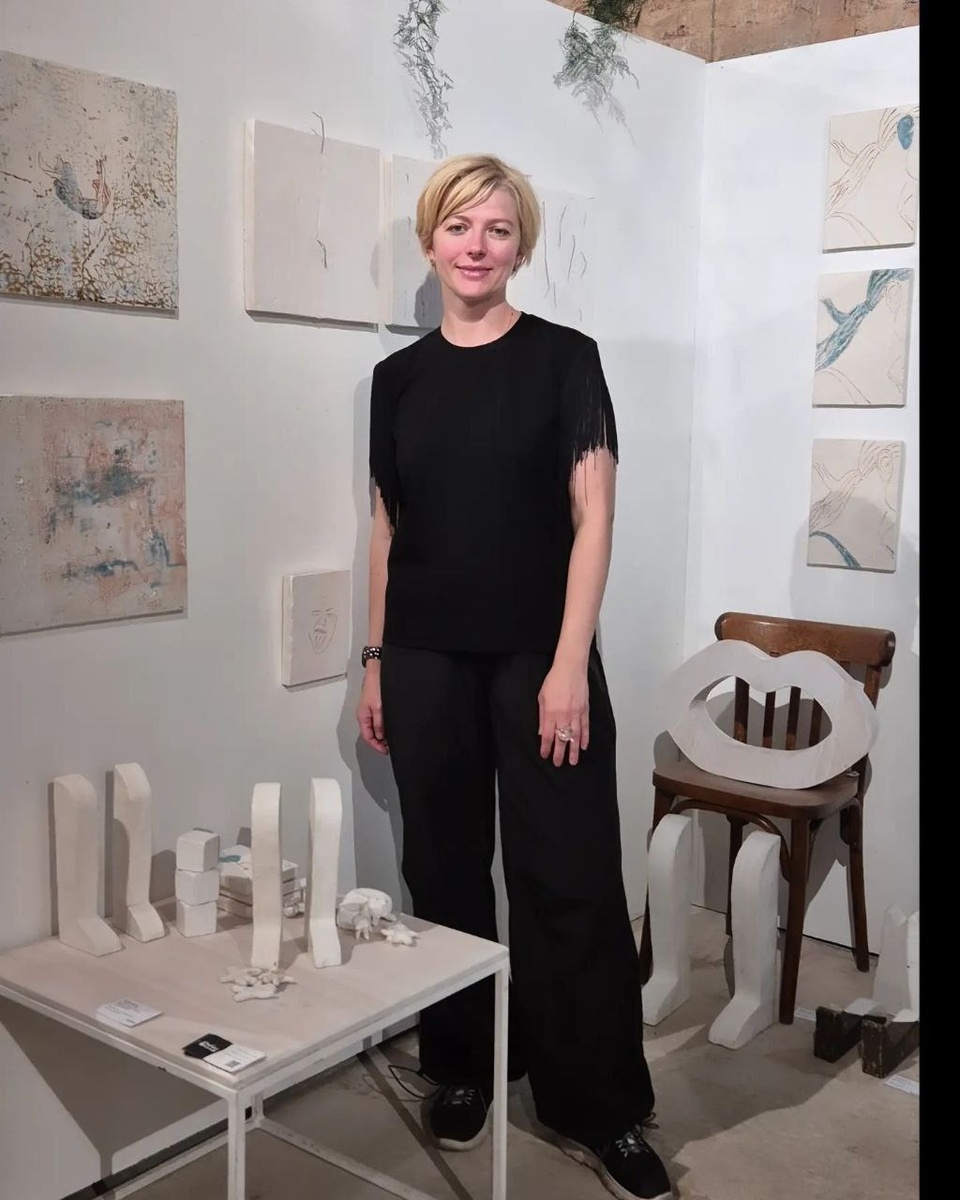
Why did you choose clay, and how do you feel the material?
God made man from dust, from clay, in his own image. I take that as a sign of sorts. What I have to say as an artist has to do with human nature — its thoughts, its fears, its passions.
Ceramic is almost stone; it lives for thousands of years. It ties me to the past and gives me a way through the present into the future. I sculpt my own reality, quite literally.
I often work on several projects at once. One theme flows into the next and fills it out. That, I suppose, is how an artist’s individual pattern forms inside the kaleidoscope of the art world.
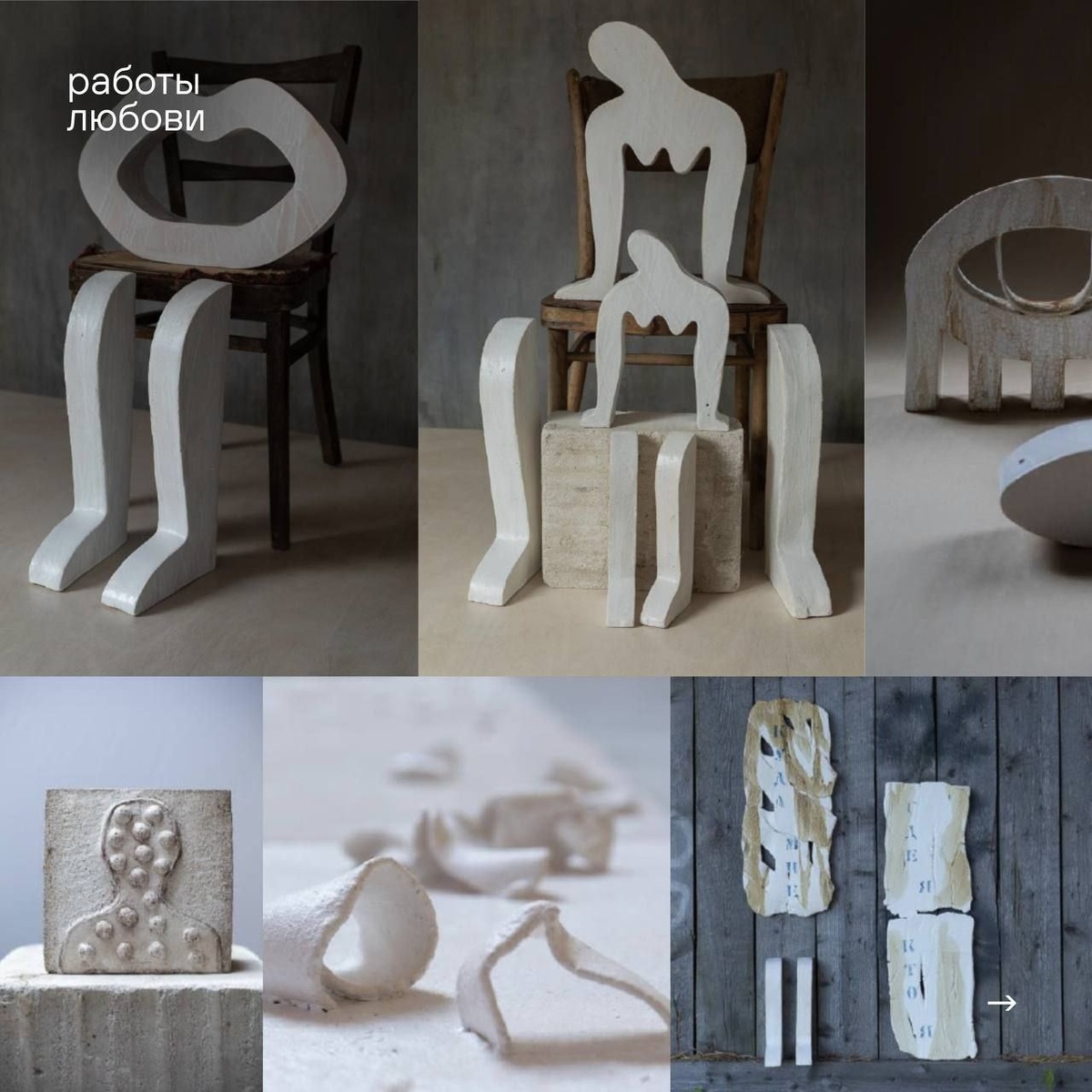
How did you come to work with installation? What made you go beyond the traditional scale of ceramics?
I became convinced that whatever you pull out of your own depths without looking back turns out to be the most important and the most worthwhile thing.
In “Andrey Tarkovsky. A Cinema Prayer”, Andrei Tarkovsky says that an artist feeds on his childhood all his life — that the childhood determines the art, an unconscious dependence and connection.
I was born and grew up in the north, in the Komi Republic, surrounded by endless snow most of the year. My restraint and economy, all that white, the search for a pure form — it all comes from there. What I’m doing is developing fragments of a film my eye exposed a long time ago.
That inner sense of open space is, I think, the decisive factor. The need for the eye to travel into the distance and the thought to travel inward.
What makes installation interesting is that it has so many points of entry, of contact, of sensing the space and yourself inside it.
For large works I encode the information in a simple way. It’s very hard to stay meaningful while being brief and austere. That, too, is a riddle I set myself and solve at the same time.
What themes do you enjoy raising in your art?
In my work I often talk about what is always invisibly with a person: the movement of thought, patience, tension. About the things you can’t touch. Out of that comes the idea of recording the invisible. First I make objects. They stand on their own, but you could also call them a search. Larger projects are then imagined and built out of these pieces.
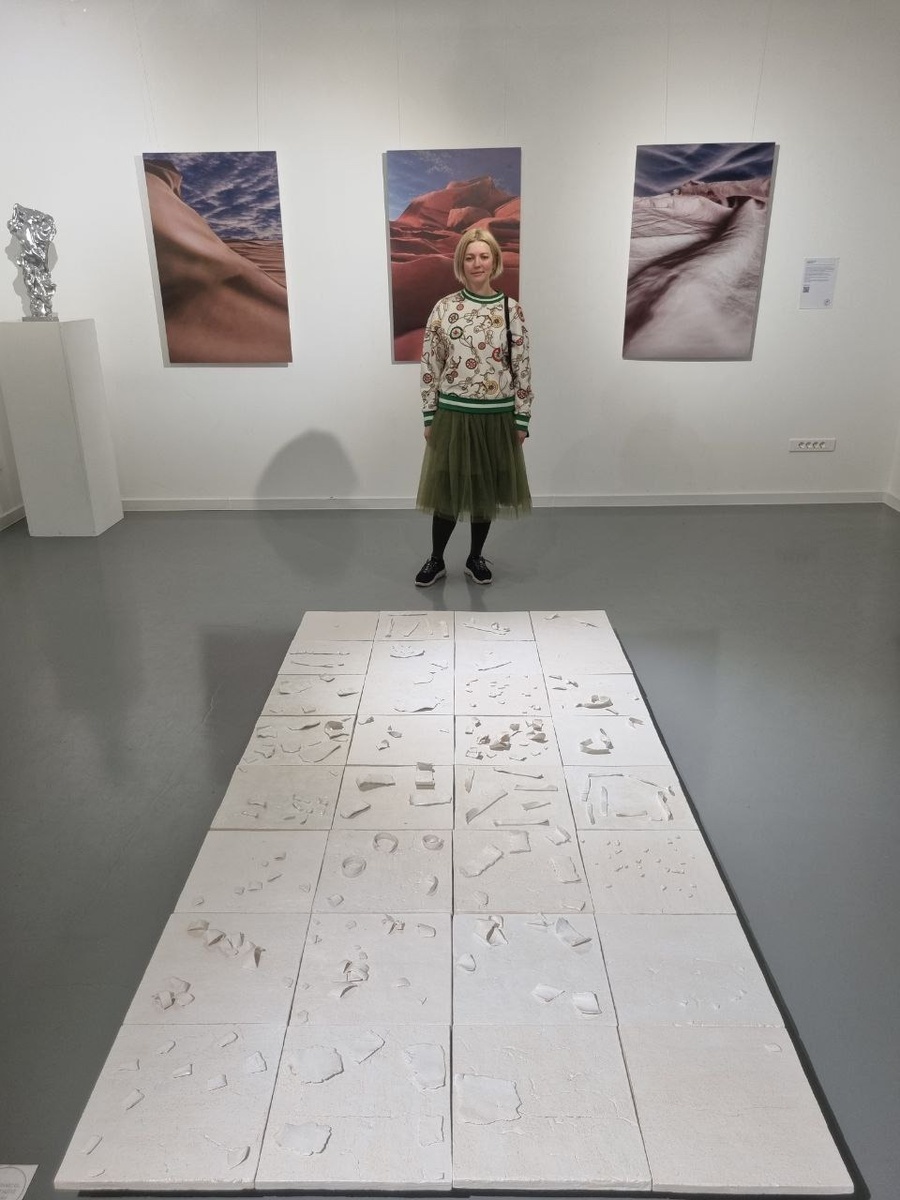
“Mental Landscape” (a ceramic installation, 132 x 264 cm) is a plateau, the starting point of my professional path. It’s a theme you can develop in depth and in breadth, in the moment and over long distances.
Millions of thoughts vanish without a trace. My hand seals in particles of the plasticity of thinking as it happens. The mental landscape becomes a microcosm, a way of stepping outside the inner world. That state becomes the core of a matryoshka of meanings.
Its middle layer is the break-up into a multitude of possible thoughts, and then the search that brings them together into a project.
The outer layer is an understanding of the general landscape of the time we live in.
When this installation is shown, weightlessness matters — it creates the sense of fragility. It looks as if one touch and everything will slip away and break. And at the same time reassemble into something new.
What part does psychology play in your art?
An interest in psychology and in a person’s inner landscape, the fact that I’m a mother of several children, and how close I am to the world of children — all of that led to anthropomorphic objects and subjects.
Among the photographic works, an important series is “The Little Grey Wolf Will Come” (2021). Everybody knows the theme I’m opening up in that project. There’s a small one living inside each of us. The “inner child” is a composite psychological image, an exact copy of the person in childhood. The project thinks through how upbringing shapes a child’s psyche. Deliberate or unconscious, fleeting or repeated, quietly traumatic and deeply toxic — the breaching of a child’s boundaries makes itself felt later in every adult.
The theme carried on logically into ceramics. The installation “These Events Are Not Happening to You Right Now” is an immersive project in which the artist’s impulse makes the viewer remember their own trigger, the splinter they picked up somewhere along the way.
Do you see addressing psychological themes through art as a tool, a support, or an artistic statement?
I think it’s all three at once.
My personal theme is deliberately encoded into shared collective memory. The viewer lives through their own experience by way of my message, my artistic statement.
Sigmund Freud said that this communication happens on an unconscious level: art serves as the link between the artist’s unconscious and the viewer’s; the joining and the revelation that come with contact with art can nourish feeling, thought and vision, and relieve both the artist and the viewer of their anxieties.
That’s why art pulls us in, and why we keep going back to exhibitions.
What is your mission, as an artist and as a person?
There’s a study saying that artists make up 1.5% of everyone living on earth.
With their hidden “weather station” they pick up sensitively on what is happening around them, interpret it, set a direction, show the reverse side, provoke communication.
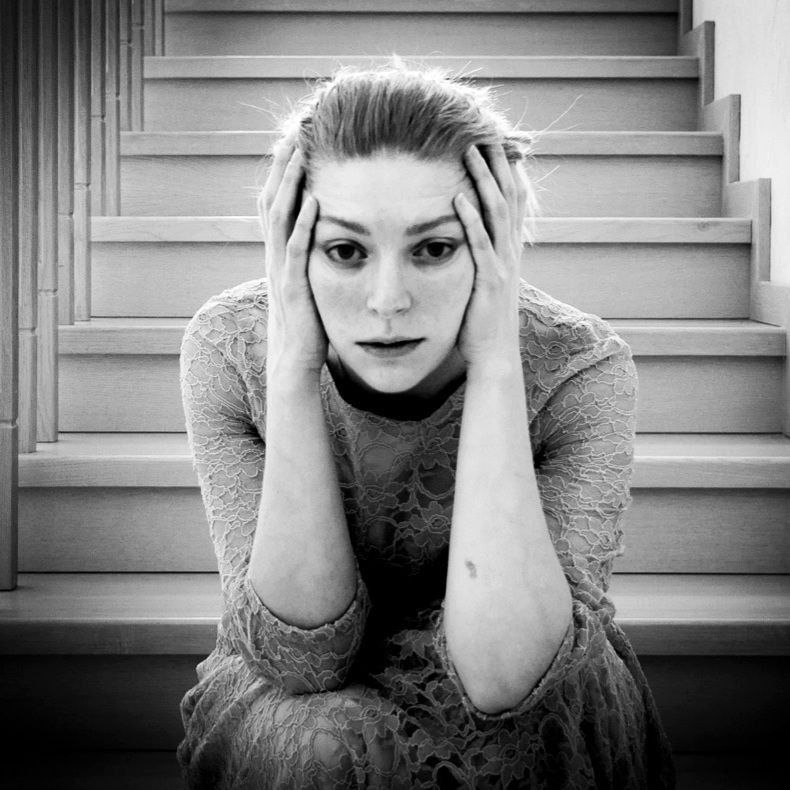
The conversation can go all sorts of ways. Superficial, ritual, or deeply frank.
When I let a work go, I’m letting people look at the world through my eyes. The viewer makes their own discoveries by reading my thoughts made material. That dialogue makes both of us grow.
The person and the artist are one whole in me. Only on that frame can I manage not to betray myself, in life or in art.
Is there a phrase or a thought that keeps you going?
“To everything there is a season,” from Ecclesiastes.
“To everything there is a season, and a time to every purpose under the heaven.”
I read a message to the artist in that too. Walk your own path. Work. Everything in its own time.
What effect did the “I Want Into the Art World!” program have on your work?
I can say it plainly and with confidence: it was useful.
From the first free content I watched, I knew this was where I needed to be. If people share this generously for nothing, there must be even more inside.
I liked how clearly structured the program was. The module on how the art world is put together was a real breakthrough, because the information is detailed and comes with a practical approach. There are a lot of assignments that take you to a new level. You absolutely have to do them. The mentor gives, and it’s on us to take the whole layer of knowledge on offer.
The artist’s myth is a particular love of mine. The right questions helped me look inside myself and find what sets me apart from others, and see what my statements as an artist rest on. Working through that section made my artist’s documents much stronger.
I put my knowledge of the history of contemporary art in order. My chaotic inner library started to arrange itself on shelves. The suggested way of studying art through colour, form, meaning and space is a useful trick, and also a little key to understanding your own methods.
I also made a note of the important habits of an artist’s life. Each of them is very simple. That’s the power of small steps, the only way to eat an elephant.
Pricing, who does what in the art world, psychological resilience, presenting yourself, working with text, thinking big — I could go on listing the good things about this program.
What matters is that I didn’t pick the wrong course, even though I came in not as a beginner but with a certain amount of experience behind me.
Want to build a career in art?
OnStudy online programmes, led by curator Maria Hiltunen-Sedoshenko: art management, selling art and building an artist’s career.
 WhatsApp
 Telegram
 I have a question

