


 All Programs

Artist Bio: A Short Example and Three Formats Explained

An artist’s biography is a continuous piece of prose built around their achievements in contemporary art. In practice it often becomes a concise, compressed format: where the artist was born, where they live, which theme they work with and what professional results they already have. If you are looking for an example of an artist bio, you first need to decide where the text is going: an open-call form, a portfolio, a website or a catalogue. There is no single universal version for all of these purposes.
The confusion usually arises between the biography, the CV and the artist statement. The CV shows the detailed history of a professional practice. The artist statement talks about the artist’s art, while the biography talks about the artist as a person, within the limits of their professional practice. That is why it takes some of its information from the CV but does not turn into a list of exhibitions.
The catalogue biography is a separate thing. There you can say more about how the artist was formed, about events in their life, their art education and how their practice has changed. For an application package this logic is usually unnecessary. When we write a short biography for an application, we are facing a completely different task.
A bio is a cross between a life story and a CV
A CV can potentially run to several pages. It holds the artist’s full exhibition history, education, residencies, awards, publications and other professional entries. An artist with a long practice may have a great many exhibitions.
A biography gives an immediate sense of the level at which the artist has come to us now. Say the CV lists 30 exhibitions. To grasp the full extent of the exhibition practice, an expert can open the CV and look through those 30 entries. A biography does not need that much information.
We choose the exhibitions whose level shows how far the artist has come in their professional practice. If there are significant awards, residencies or works in collections, they can go into the text too. The biography sums up this experience and turns it into a coherent narrative.
That is why the phrase “a biography without its main exhibitions falls apart” describes the problem so precisely. You can write a good text about yourself, say what interests you and what you are researching, but without professional facts the reader will not understand what stage the artist is at.
The opposite also happens. Artists’ websites often have a Biography section that has in fact been reduced to a recital of the CV. The result is a CV seen through the lens of a biography. Formally the information is there, but hardly anything remains of the continuous prose.
The second extreme looks even simpler: a few very general sentences that reveal nothing. That is why I would not look for a single formula or a ready-made template. There is no universal text into which you can drop your own details and get a biography that works.
A bio should tell the reader everything about the person within their professional practice
An artist’s autobiography and an artist’s professional biography do different jobs. The person lived before they began making art. They had an education, occupations, moves from place to place, personal experience. What goes into a biography for the art world is the part of that story which helps the reader understand the artist and their art.
Through the biography we understand whose eyes we are looking through when we look at the works. If the artist has moved around the world a great deal and a blend of different traditions and experiments can be read in the work, it makes sense to bring out that part of their life. There is a direct link here between a person’s experience and what we see in the art.
The same logic applies to education. A person may have trained in a field that formally has nothing to do with contemporary art but has strongly influenced their practice. An architectural education, for example, may be connected with the way an artist works with space or rhythm. In that case the education helps explain where the visual language comes from, and it has a place in the professional story.
If an earlier occupation has had no influence on the current art, there is no need to list it for the sake of completeness. Our task is not to present ourselves as a many-sided personality and give the reader our whole life story. We need to give a brief idea of what kind of artist this is and what stage of their career they are at.
That is why a story about childhood and inspiration does not replace a professional biography. A catalogue text may well begin with the artist becoming interested in art at the age of six, then going to art school, and later living through some event that changed the way they see things. In a catalogue, a story like that can work. In a short biography for an application, it takes up the space of the facts by which an expert assesses a professional practice.
A short bio can be three or four sentences
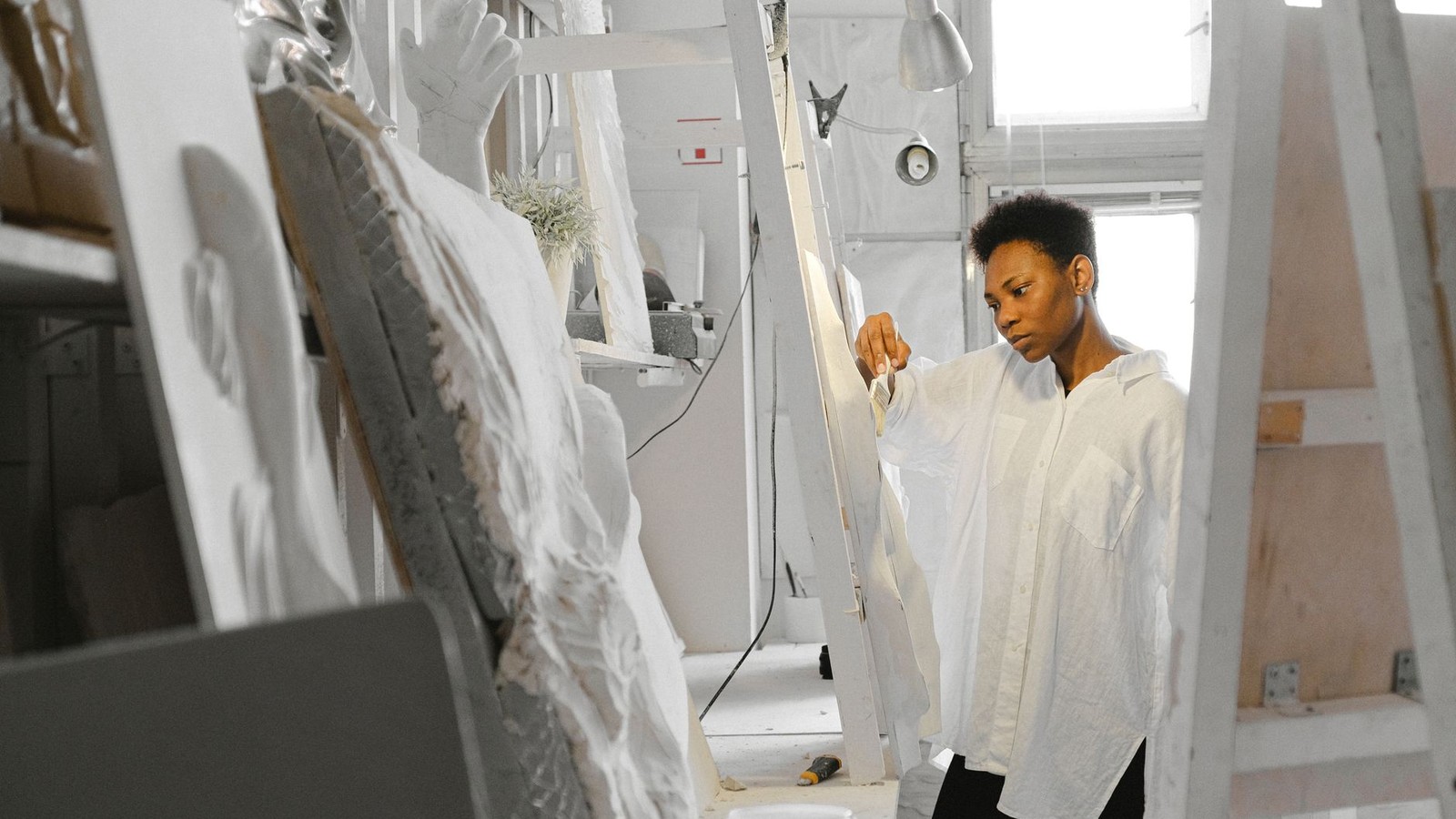
For an open-call form, a very short version is often enough. It can state the city and year of birth, education, where the artist now lives and works, the theme of their practice and a few professional results.
For example:
The artist was born in 1991 in Leeds, received an art education, and lives and works in London. In her practice she explores memory and the connection between personal history and place. She has taken part in group projects at regional institutions. Her works are held in private collections.
An example like this shows the principle itself; it is not a text to be copied with a few words changed. Another artist may have no art education but does have an exhibition history. A third has no works in collections yet but has taken part in group projects. A biography is assembled from the professional experience that a particular artist actually has.
If an artist is only beginning their career, there is no need to inflate the length artificially. A few precise sentences work better than a long account that contains no professional facts anyway. As the practice develops, the short version will change.
An extended biography for a website and a portfolio does a different job. Here you can show the professional path in more detail, connect particular life events with the art, and name more of the significant exhibitions. The text is still a biography, but it now has room for context.
A website gives more freedom. There the biography can sit alongside the CV, the artist statement, publications and separate pages for exhibitions. The reader does not have to get all the information from one text, because the details can be moved to the relevant sections.
A catalogue biography is freer still. It can include the story of how the artist was formed, an account of their art education, important periods and changes in their practice. A catalogue assumes a more detailed acquaintance with the artist, so a text that works well in a publication should not be transferred mechanically into a form field of a few hundred characters.
This gives three working formats with different densities of information. The short version introduces the artist quickly. The extended one helps the reader see their professional path in more detail. The catalogue version can tell the artist’s story far more broadly.
A bio without its main exhibitions falls apart
One of the most common problems arises when an artist tries to write about themselves beautifully and ends up removing almost all the facts. What remains is research into memory, a search for connections, reflections on people and space. A text like that may sound good in itself, but no professional biography can be read from it.

Another version looks like a list of exhibitions. Year, project title, venue; next year, next project. What we have in front of us is effectively a CV, simply moved from a table or a list into the Biography section. In a biography, this information has to be selected and assembled into coherent prose.
A story about childhood works in a similar way. The artist explains in detail when they started drawing, who first took them to art school and what they were interested in when they were young. If this experience does not help the reader understand today’s art, the text still contains no more professional information than before.
There is also the problem of different versions. On the website the artist gives one professional story, the portfolio still carries an old biography, and a third one appears in the application. The short and extended versions may differ in length, but the information itself must not contradict itself from one to the next.
The difference is easy to see with one and the same hypothetical artist. For an open call we keep a few sentences about where they were born and where they work, the theme of their practice and their most notable professional results. On the website we set out the path in more detail. For a catalogue we can add the events that help show how the practice took shape.
If you are wondering how an artist should talk about themselves, you can start from your own CV. Look at which entries in it really show your present professional level. They form the basis of the biography, and then you add only the personal context without which it would be harder to understand whose eyes we are looking at the art through.
In this way the biography remains a text about a person, the CV keeps the detailed professional history, and the catalogue version earns the right to speak more broadly about the artist’s life and development. One artist can use all three formats at once, because each of them answers its own task.
The free “Into the Art World” programme
Maria Hiltunen-Sedoshenko explains how artists can sell their work and build a career in contemporary art, from the first steps to an exhibition of their own.
 WhatsApp
 Telegram
 I have a question

